The consequences of believing in responsibility for your own life

MONDAY, 13 JANUARY 2020

Taking responsibility for your own life is, the more I think about it, an extremely dangerous opinion to hold in the Politically Correct/Crazy Culture War Era.

If you draw taking responsibility to its logical conclusions, the slave was partly responsible for his own slavery, and so-called non-white groups in South Africa were partly responsible for their own suffering and sometimes miserable lives during the pre-1994 era.

Of course, the slave owner had the authority of the colonial establishment on his side. But if we only look at the history of slavery in North America and the Caribbean, we see that thousands of slaves did claim their freedom, and in many cases lived out the rest of their earthly existence as non-slaves – though they always had to be on the lookout for enemies who wanted to lead them back to slavery (see the Haitian Revolution, and the Maroons in Jamaica).

The South African apartheid state was also powerful, and many so-called non-whites who resisted the white state were killed – sometimes brutally. But there were at least eight non-white people for every single white person in the decades before 1994! If non-whites in more significant numbers refused to allow white political leaders to dictate to them how and where and with whom they should live, what could the white state and the white minority who supported them have done about it? Some people say there would have been a blood bath, ten or a hundred times worse than Sharpeville in 1960 or Soweto in 1976. But was violence the only solution? India during the British colonial era is also an interesting case: How did fewer than 200,000 British soldiers and officials succeed in subjugating to their authority a population of more than 200 million Indians?

Is there a middle ground between, “I am not in control of my own life and am therefore a victim of anyone who is stronger than me, or who convinces me that he is stronger than me” on the one hand, and on the other hand, “Over my dead body will I allow you to master it over me”?

It still feels like I’m caught up in a political and socio-cultural dilemma. I believe that, as a relatively intelligent adult, I am largely responsible for how I experience my existence. I further believe that all relatively intelligent adults are to a large extent responsible for how they experience their existence. But if this is true, how on earth can I continue to believe that 80% of the population of South Africa were victims before 1994?! Were my parents and other white people before them so breathtakingly powerful? What type of magic did they practice?!

I believe many children and grandchildren of people who suffered before 1994 because they were black or brown or Indian have already become wise to the truth: that the white man and woman were not really that powerful. That their parents and grandparents and other ancestors did not push back hard enough when the whites dictated terms. A critical percentage of black, brown and Indian South Africans mostly accepted the dictated terms, hoping a miracle would occur in the future that would save them. I believe that many children and grandchildren of black and brown and Indian South Africans who suffered before 1994 are deeply upset with their parents and their parents’ parents, but because they love them, they have created a caricature that can be more easily criticised, and on whose shoulders all the blame can be placed.

Afterthoughts

Tuesday, 28 July 2020

One: There were indeed numerous examples of individuals and organisations in South African history, just in the period 1910 to 1990, who realised what a big problem psychology was – that a significant percentage of white people believed it was their right to rule over other groups, and that a significant percentage of non-white South Africans also believed that this should be the case. These people and organisations understood that education was a key to a better future, that what Marcus Garvey (1887-1940) had written should be applied: “We are going to emancipate ourselves from mental slavery, for though others may free the body, none but ourselves can free the mind.” One of the biggest proponents of better mentality was Steven Biko (1946-1977). No wonder the apartheid state was eager to get rid of him. There were also numerous attempts to get thousands of people involved in campaigns against the apartheid state, including in non-violent marches and protests. Eventually, apartheid did come to an end, and was replaced by a more democratic order. Why? Because a critical percentage of the white population accepted that they did not have a right to rule over other groups, and a critical percentage of black, brown and Indian South Africans came to see not being able to choose who rules over them as an undermining of their rights. A massive psychological shift among all the population groups of South Africa therefore had to take place before reality could change for everyone. By 1994, this shift had taken place, and the reality changed.

Two: White people who took actions that actively hindered other South Africans’ hopes and efforts to lead good lives (including National Party politicians, officials who carried out government policies, and members of the security police) were fallible people who gained positions of power, and who learned day by day that they were getting away with the abuse of their power. A significant number believed their cause was just – a fight against Communism, and therefore for the Christian faith and Western civilisation. Many of these white agents of the apartheid state, these perpetrators of a morally corrupt ideology, were otherwise good people – people who loved their spouses and children, and who were good sons and daughters to their elderly parents. It is this complexity I cannot ignore when people present a simplified history where on the one hand you had powerful evil monsters, and on the other hand poor powerless victims who could only hope for a better day.

Wednesday, 29 July 2020

1. There’s this impression – that people suffer and complain, but don’t do enough to change their circumstances, or to improve their lot. Later, when other people changed their circumstances for them, they tend to favour a narrative that hides the fact that they didn’t take more initiative to improve their own lot.

2. I believe in the enormous capacity of the individual – and when enough members work together, the collective capacity of the community – to improve their own circumstances and their own experience of reality. Often, people fail to do this. But acknowledge it then. To opt for a narrative that portrays yourself, or the ethnic, or cultural, or socio-political group of which you’re a member as poor victims, does incredible damage to your own perceived capacity to improve your circumstances and your experience of reality. What message do you send to younger, impressionable people who are forming ideas of what they’re capable of? Too many people opt for anger at some perceived almighty other group that have somehow monopolised political, economic, and cultural power, and have managed to sustain it for decades or even centuries. Are these people powerful wizards? Do they practice some other-worldly magic? Chances are that you are exaggerating their power and ability in order to conceal your own poor record of doing better.

Sunday, 16 August 2020

I’m returning to this piece yet again because it’s easy to misunderstand – or maybe I haven’t made myself clear enough.

So, hopefully just one last time, three points:

1. Afrikaners, and other white people in pre-1994 South Africa, did have political, economic, and military power, but their power was not unlimited. An acceptance – for all practical purposes, even if people didn’t like it – of the political and social order during apartheid, and before that, among all the population groups of South Africa was the most powerful instrument in the hands of the white government.

2. Embracing a victim identity is less valuable than accepting that whatever happened to you or your family might not have happened if you had tried harder to avoid it – if you had taken more responsibility for your own situation. Now – no one needs to point out to me that it sounds like victim blaming. There is never an issue of placing less blame on the offender, and more blame on the victim. The offender is guilty and deserves to be punished for what they have done to another person. Offenders must take responsibility and suffer the consequences for their actions. But if the victim could have done nothing to avoid or reduce their pain and suffering, they are one hundred percent victim – one hundred percent powerless. This is the highest level of victimhood. Someone messed with your life, and there was nothing – nothing! – you could do about it. It is tragic that every day there are such cases in every country, and every city and town and sometimes farm and hamlet in the world. This is what happens to children who depend on adults for protection, and for making good decisions. This is also what happens to old people who are no longer in control of their lives. This type of victimhood is terrible because not only does it involve pain and suffering and loss, it also reminds you every day that you think about it that you were absolutely powerless to change any aspect of it. People can criticise me all they want, but I simply do not accept that millions of adult black and brown and Indian South Africans before 1994 were one hundred percent powerless victims. Children, yes. But once you are old enough to be in control of your own movements and decisions, you have choices. Thousands of slaves decided to escape during the period of slavery in the Western colonies. Millions decided to stay on the plantation instead because the risk was too great. There are people who claim that to say they decided to stay implies that they chose to be slaves. I say: at least I see them as rational people who made choices, even if the options were limited. I do not see them as brainless bodies. I see them as people who faced a terrible choice and who chose the less life-threatening option. However, were there slaves who accepted the social order where they were slaves and white people their masters as God-given? I believe there were many people with this mindset who eventually had to be freed from their mental slavery. Taking some responsibility for your past situation is empowering. It tells the one who played god over you that he or she was not really as powerful as they thought they were. It says: “My own failure to push back harder, or to push back more effectively, made it easier for you. Don’t see me as a victim anymore, because the other side of the coin is that I have to admit you were smarter, stronger, and more powerful than I was.”

3. I have friends and family who see themselves as allies of the suffering black man and woman. A black man or woman’s success is celebrated when a similar success would not be celebrated if the person was white. This idea of looking at a person, and deducing from his or her skin colour, or gender, or sexual orientation that they are victims of someone else’s personal power, is intolerable to me – intolerable! And if you listen to what many black people say, they also find it intolerable, and insulting. I can’t for the moment quote a specific black person who said it in so many words, but I am sure the following sentiment is widespread among black people who follow these trends: “Don’t see me as a victim. You and your ancestors were not really that powerful. I – and my ancestors, made mistakes, and did not push back hard enough, or smart enough.”

______________________

Managing to get my stuff together

MONDAY, 6 JANUARY 2020

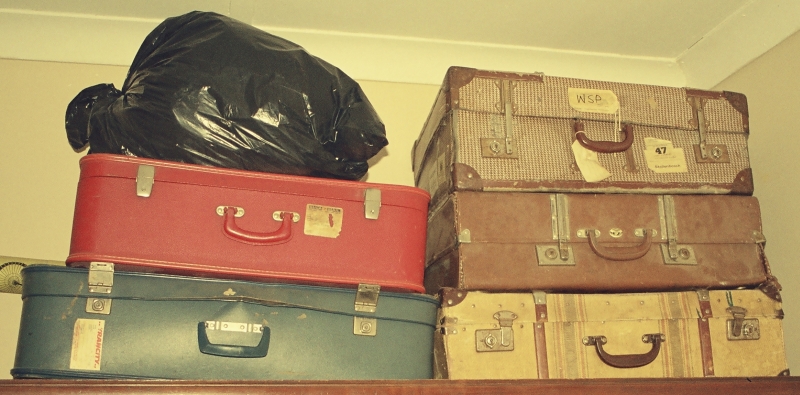
For years, I’ve been having dreams where I’m heading to the airport or train station, and I’ll be on time … if I can only get all my luggage together – which seems impossible because I have too many items to carry.

Some time ago I dreamt about a dilapidated apartment building in Taiwan, where boxes and boxes full of my stuff were stored. The ceiling was cracked so it had been raining in, and the walls were mouldy and it was a big mess. But I had so much stuff I couldn’t get it all together.

Saturday night/Sunday morning I again dreamt of an old apartment that I was renting from a “Mrs Zhang” – basically just two rooms in a house or apartment. And once again, my stuff was all over the place. Except this time, after a while, I realised that I was actually gathering up the final items – the last bits of paper and the last few ornaments and souvenirs and bits of broken electronics – and putting it all in one last box. And then the place was clean. I had finally managed to get all my stuff together, and/or sort it all out.

There was no airport or train station in the dream, though. Maybe that’s next.

______________________

Tuesday, 31 December 2019

TUESDAY, 24 DECEMBER 2019

I realised tonight that next week is not just the end of a year, but the end of a decade – my third end of a decade as a full-fledged adult.

The first decade after high school started for me in a missionary house, with me part of a team hoping to convert more people to the Christian faith. The decade ended for me in the streets of Hong Kong, very far from home, and even further removed from any kind of certainty about my own future.

I started the ’00 decade as an overweight smoker with a bad attitude and a problematic self-esteem. Ten years later, I exited the decade at a bit of a low-point – less overweight, no longer a smoker, but financially relatively broke. And I was already 38. The decade did include some of the proverbial best years of my life: I started writing in 2003 as if a fever had taken hold of me, and by the middle of the decade I had met a woman who could only be described as an angel descended from the seventh heaven upon my earthly existence. Nevertheless, the highlights were in the middle of the decade; the end would have made any mortal anxious.

And so began my third decade as an adult. In 2011 I turned 40. I continued with a variety of projects intended to bring about more financial security, and I returned to my writing with renewed dedication. This decade had highlights of a different intensity, and the lows were not quite as low as in the previous decade.

TUESDAY, 31 DECEMBER 2019

What are my predictions on the eve of this fourth decade of my adult life?

No predictions. No short speeches to motivate myself. I’m already happy. I’m already doing much better financially than in previous decades. I’m already living the fuller life I dreamed of in my twenties and early thirties.

Am I prepared to do even better? Am I ready to travel even more, give more, provide more assistance, do more of what I am already doing? Am I ready to experience even more of life? Is there a fuller version of me that I’m already becoming as I type these words?

* * *

One fairly wealthy friend of a friend mentioned this year that the life we – Natasja and I – are living is closer to the lives of billionaires than to the lives of people struggling for survival. “Sure,” he said, “billionaires have fine Egyptian cotton linen and they live in bigger houses, but you – like them – have running water, modern plumbing, stable electricity and high-speed internet. Compare that to people who live in shacks with no running water, no electricity, no internet …”

I was also reminded recently of an old truth: There are things we have no control over; there are some things we have partial control over, and then there are things that depend to a significant degree on our decisions – if you choose this path, then this is the path you’ll be following for the next few months, and maybe for the rest of your life; if you choose that path, that would be the path you’ll be following for the next few months, and maybe for the rest of your life. It is therefore wiser to focus instead on the aspects of your life that you do have the most control over. And if you tend towards honesty and a critical view of things, you’d recognise that you have sufficient control over your own life and the environment in which you live to create the fuller life of which you could only have dreamed when you were younger.

______________________

A topic I don’t really want to think about

FRIDAY, 1 NOVEMBER 2019

15:58

What follows is the most recent note on a topic I don’t really want to think about. If more than ten people regularly read what I write, notes on this subject will definitely get me in trouble. Nobody – but especially not white people, and then especially not white men – is supposed to form any thoughts on this subject that are not in line with approved mainstream ideology. “Why would you after all have any other types of thoughts about it?” anyone might ask. “Are you a bad person? Are you wicked? Are you the devil?”

As is often the case with normal people, thoughts form in my head while I’m in the shower, or on my way somewhere. And because I’m not in the habit of placing a proverbial guard at the gate of my mind, all sorts of strange questions come up. And seeing that the question was then asked, I must address it. Or, I certainly don’t need to address it – especially when I know we’re only supposed to have pre-approved thoughts on certain topics. But I will be constantly aware that it is on the table and that I am ignoring it.

Anyway, here’s the thought. How did the policy known as Apartheid become the reality for so many people – of all races – in South Africa, between at least 1948 and 1990?

A simple explanation is that Apartheid was allowed to become and remain the practical reality for so long because the majority of the population – and the majority of the population were black people – had accepted Apartheid. Naturally people had a negative view of the policy and the political leaders they held responsible, but a critical percentage of the affected population accepted it as the way their society was managed.

Why was Apartheid eventually replaced by a better policy? Because a critical minority among the black population, with allies among other population groups, did not accept Apartheid, and dedicated their lives to undermining it and destroying it as a framework and policy by which the state was governed and the population controlled. This critical minority, which included people like Nelson Mandela and other leaders of the anti-Apartheid movement in the fifties and sixties, as well as Steve Biko and other activists in the seventies and eighties, but also thousands of other leaders who had close ties with the community on a daily basis, finally convinced a critical percentage of the population that they should be supported in their efforts to end Apartheid, and that everything would be better for them when they, the new leaders, were in control of the state.

16:49

The fact is, almost thirty years after the end of Apartheid, there are still white people who believe that Apartheid was “not so bad”, and that “even black people were happier under Apartheid than under a black government”. And there are black people who believe that they were passive victims of something bigger than them, and that they could mostly just wait until their leaders rectified the matter. Both of these opinions are wrong because the truth is a bitter pill to swallow.

(By the way, never trust an academic who doesn’t have a source of income that is independent of the institution, school, or university where they work. By the end of the second decade of the twenty-first century, it is common knowledge that academic institutions follow political agendas, and if academics do not endorse the dominant political ideology, their salaries – with which they pay rent and buy food and clothes – are at stake.)

TUESDAY 26 DECEMBER 2019

12:48

Does it make the misdeeds of the man who physically abuses his wife less evil because she stays with him day after day, month after month rather than escaping with her life?

No.

But what message does it send to women in abusive relationships to refer to them as powerless victims? What hope does it give to women in such relationships?

In the end, you are left with two options:

Option 1: See the woman as a powerless victim. In this case women who never left their abusive husbands don’t have to feel that they could have done anything to improve their own situations. The message to women who are currently involved in such relationships is that they should just hope someone saves them. Because they themselves are powerless.

Option 2: See the woman in a relationship with a man who is physically and emotionally abusive as someone with the ability to do something about it. She would probably have to be smart and courageous to protect herself and possibly her children, but she does have the ability and power to improve her life. This is good news for women who are currently trapped in such a relationship. But the message to the woman who had been in such a relationship in the past, and only got away because her husband died or something else happened to him, is that she could have done something about her situation – but unfortunately never got that far because perhaps she always thought of herself as powerless.

* * *

Seeing that I’m already politically incorrect, and stepping on sensitive toes, another question: When did the oppression of the black population begin in South Africa? Libraries full of research have been done on this, and perhaps my argument could be shot down with a battery of artillery fire from people smarter than me.

At this point I must also make clear that I am referring specifically to the black tribes and other black groups as was known to political leaders and white citizens in the eighteenth and nineteenth centuries.

The history of power politics between white people and coloured people in mainly the Western Cape, between white people and the San in initially the Southern and Eastern Cape, and between white and Indian people in originally KwaZulu-Natal, is different from the history between white groups and various black tribes and nations. Slaves revolted from time to time. The San waged guerrilla war against white farmers and communities. The Griquas forged alliances with other groups and also came into military conflict with white communities on their own.

But between whites and blacks, there were at least a dozen conflicts that qualified as war. There were the nine border wars in the Eastern Cape, and a few uprisings. There were three wars between the Basotho and the citizens of the Free State. There were several bloody wars between the Voortrekkers and later citizens of the Transvaal and Natal and the Ndebele under Mzilikazi, and the Zulus under Dingaan and later other leaders. And then there were several wars between British colonial powers and the Ndebele, and the Zulus. Most of these military conflicts had come to an end by 1880. Up to this time, black and white fought each other as equals. One could argue that white soldiers had guns and cannons, but black warriors had other advantages, not to mention the fact that they could also get their hands on guns – and did use them, as in the Anglo-Zulu War of 1879.

My point here is that I have difficulty swallowing the narrative of the black person in South Africa as a powerless victim of white domination for 300 years. This narrative clearly has political value in the South Africa of the twenty-first century, but I find it extremely strange when people dismiss as insignificant the military power of black nations in the eighteenth and especially nineteenth century. Have these people never read descriptions of Xhosa or Zulu warriors? Have they never read of the military victories that Mzilikazi and Moshoeshoe achieved over white commandos?

My question is again: The oppression of blacks by whites that was such a feature of twentieth-century South African society – when did this chapter begin in the conflict between whites and blacks in Southern Africa? I think the 1880s are a good place to look for an answer.

My next question: After at least a century of sometimes successful resistance – where armed warriors stood against armed militias, how did it happen that the oppression of black people was carried out so extensively after 1880?

14:25

I don’t see black people in South Africa as long-suffering historical victims. There were events like Sharpeville in 1960 and Soweto in 1976, and there were government policies like the passbooks and forced removals, but those were all in the last hundred years. When I think of historical black figures, I see the Xhosa warrior on the Eastern Frontier; I see the imposing figures of Mzilikazi and Moshoeshoe; I see the intimidating figure of the Zulu warrior on the green hills of Natal; I see intellectuals like Sol Plaatje and Steven Biko; I see political leaders like Oliver Tambo, Nelson Mandela, Walter Sisulu, and their wives Winnie Mandela and Albertina Sisulu. I see the period 1880-1990 as a historical anomaly during which a critical percentage of black adults in South Africa seemingly accepted that they were second-class citizens of their country of birth, and when a critical percentage of black adults accepted that their children would become factory workers, gardeners, road workers and domestic helpers rather than engineers, doctors, dentists, scientists, and academics.

______________________

One or more insights I recently picked up

SATURDAY, 2 NOVEMBER 2019

Financial independence is achieved as follows: Eliminate all the nonsense and all the options that don’t work for you or that waste your time, and repeat week in and week out the steps that do work for you.

THURSDAY, 21 NOVEMBER 2019

17:33

Thought one: A certain type of statement that cannot be refuted but which either manifests or does not manifest depending on your actions: You are x number of steps away from complete financial independence; You are x number of steps away from your ideal weight, and so on.

Thought two: Another statement that cannot be refuted: A complete list of values that can be delivered to a specific community yields at least one item that you can deliver for a fee.

Natural next question: What community?

23:06

When you talk about making money/receiving money, you are talking about either speculating or selling.

When you talk about selling, you’re talking about providing value to a specific community (or market).

The question, again, is what community, and what value.

I sell to a local language centre my time and my ability to lead an English class.

In other words, they buy my time and a specific ability.

But, as it is with these things, there’s another layer. Because what they’re really buying is my value as a cog in the wheel of their money-generating machine. (Sounds nasty but it works out well enough for everyone.) This value does come in the form of my time and my ability. The students, on the other hand, buy a product at the language centre that will give them the value of improved language skills.

MONDAY, 25 NOVEMBER 2019

12:11

• Accept responsibility for yourself and for the situation in which you find yourself. (This applies if you’re happy with your situation, but also, of course, if you are not.)

• Be grateful, every day, for what you already have.

• Believe in your ability to improve your life and your living conditions by changing how you think about yourself, and about your life.

• Believe that you will see more positive things when you expect more positive things (and see more negative things if you expect negative things), recognise more to be grateful for when you’re intent on searching for such things, and see more opportunities to improve your life if you expect the opportunities to appear to you.

• Eat healthy food, make sure you get enough rest, and exercise regularly enough so that your energy levels are such that you can take the actions you need to take. It’s to a large extent a reinforcing loop: follow a healthy diet, sleep enough, exercise daily … have more energy, which will make you want to take the steps you need to take, the doing of which will again motivate you to eat healthy food, get enough sleep and exercise the next day. On the other hand, if you eat foods that make you listless you’re less likely to exercise, and because what you eat and drink cause mayhem in your body you are less likely to sleep well; which means you’re less eager to do what you need to do to be successful.

15:13

[Some people close to me] still believe money is scarce, and that they will never be fortunate enough to experience an abundance of it. Two options for me, and for my ability to help them:

Option 1: I believe they are right, and that I too will never be fortunate enough to experience an abundance of money.

Option 2: I believe, tragic as it is, that they are somewhat ignorant in the matter, and wrong in their view. I further believe that money is in a way like oxygen: it’s all around us, and you just have to do certain things, and not block the flow, to experience it in abundance.

* * *

All you have to do is open your mouth and draw oxygen into your lungs. After all, you don’t first hold your breath trying to work out whether or not you deserve the oxygen or whether you have a right to it, do you?

Of course you have to earn the money that ends in your pocket and in your bank account – trouble tends to follow those who think they can just stretch out their hands and take money. You also have to earn someone’s friendship and trust, and another person’s embrace and physical touch.

Like oxygen, money is in abundance (according to one source, “All told, anyone looking for all of the U.S. dollars in the world in July 2013 could expect to find approximately $10.5 trillion in existence […]. If you just want to count actual notes and coins, there are about $1.2 trillion floating around the globe.”). So too the potential for friendship and positive engagement with other people and the happiness that so often results from it. But why do so many people believe they don’t deserve happiness? Why do so many people believe they don’t deserve money in abundance, no matter how hard they work?

FRIDAY, 29 NOVEMBER 2019

Most people, if they have to be fair and honest, would have to admit that there are hordes of opportunities to make a lot of money. They must know this, because there has never been a shortage of stories of people who have tried things and have made a success of it. Every week there are new products on the market that did not exist the previous year. There are new versions of old products; new versions of old stories; newer versions of old music; two or more ideas combined to make new products.

Believe there are indeed many ideas for making money, and that you are capable enough to develop such ideas, or competent enough to talk to people who will know what to do, and your brain will, like a recently reconfigured radar, pick up ideas on a daily basis. These same ideas will bite someone else on the nose, and they won’t blink an eye. Why not? Because they don’t believe it’s there. And even if they believed it’s there, they’ll think they’re unable to do anything about it.

* * *

An hour after thinking the previous thought, a woman walked past the restaurant where I was sitting near the window having dinner. She had a canvas bag over her shoulder. The words on the bag said, “There is no place like Tainan …”

The design was okay. I wouldn’t buy it, I thought, because I don’t live in Tainan, but if it said Kaohsiung …

There was nothing special about the font or the colours of the letters. I realised that with one such design you could have a thousand T-shirts, coffee mugs and canvas bags on the market, with different cities’ names on, for probably less than $30 worth of investment.

The world is awash with ideas that will allow you to bring at least a little more value into other people’s lives and make more money in the process. If you believe it, you’ll see it. If you don’t believe it, you won’t see it.

UPDATE: Saturday, 25 January 2020

I’ve been thinking a lot lately about money-making ideas, and how, if you set yourself up for it you’ll receive ideas on an almost daily basis.

This is true. It is, however, crucial to mention that you do not only want to be a RECIPIENT of ideas – you want to be an EXECUTOR of ideas. Without action, the ideas are not worth a red cent.

THURSDAY, 5 DECEMBER 2019

One of the insights I gained recently from one of the books I’m reading is that wealth appears in more than one form. You may think you’re one of those people who don’t attract wealth, but chances are you think that way because you have a narrow view of wealth – you’re only thinking of it as money.

Broaden your understanding and you may see how much wealth you attract in other forms. There are things people give you without you asking – things you need, for which you would have spent your own money if you’d had to buy it yourself; favours people do for you – which would otherwise cost you money; time you were given when you thought you had to do something but now another person is doing it; opportunities you get to meet people or learn things, or gain knowledge that all improve your quality of life in different ways.

You may succeed in attracting these things by acting in a certain way, or by being the relatively good person you are. But because it does not come in the form of cash or numbers on your ATM slip, it’s easy to ignore as the wealth you are actually attracting to yourself on a daily basis.

______________________