A name that tells you where to search

MONDAY, 22 DECEMBER 2014

A name, this everybody knows, is more than a sound that is uttered when someone specifically wants to get your attention. It is more than a drawing of lines and curls on paper for administrative purposes. A name connects you to people, and to relationships. I am not just “Brand Smit” – I am “Brand”, son of “Barney” and “Adriana”.

This connection gives you an indication of how and possibly where you should position yourself. For example, are “Barney” and “Adriana” figures in the Russian criminal underworld? Are they Inuit living in a village in northern Canada? Are they wine growers in Chile?

As it turned out, my parents are potters and business people of mostly European descent who speak Afrikaans and who grew up in predominantly Afrikaans communities in Southern Africa. This gives me something to work with, or it gave me something to work with starting a little over forty years ago.

There is an important point that I suspect many people overlook or misunderstand. This information about my cultural, ethnic and linguistic origins did not tell me who to be or what to do, it simply told me where to look for ideas on what to do or who to be. It does not say: Be this. It says: Search here.

______________________

You’re happily building your house of cards …

FRIDAY, 19 DECEMBER 2014

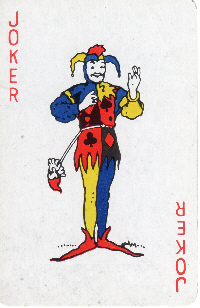
You’re happily building a house for yourself – with playing cards. Someone comes along, observes what you’re doing, and pushes the house over. The cards flutter down to earth. You’re furious. “What the fuck …” you scream. “How dare you? I was building a house – a home! Does that mean nothing to you? Does it mean nothing to you that I’ve been working on this house for the past several months?!”

“I’ve just done you a favour,” the guy starts explaining. “I understand that you were doing something you attach a lot of value to, but my goodness buddy, your home was built with cards! With playing cards! What do you think would have happened if you and your family had moved in there and a storm broke out?”

You walk away in anger, yelling filthy insults every now and then over your shoulder.

The next day you see the man again. You shake his hand. You say, thank you, I understand now. “I was so focused on my plan,” you continue, “the idea of a home, a house of my own, that I overlooked the reality of what I was doing.”

That very same day you again start from scratch.

______________________

What to do with my practical advice

SUNDAY, 7 DECEMBER 2014

A strange thought recently occurred to me: to position myself as someone who gives advice on the subject of making money from home. I even thought of building up, like hundreds of other so-called internet marketers, a mailing list of people to contact every time I write a new piece on the subject, or when a new product comes on the market that might be useful to my readers.

Why shouldn’t I do it? Because it is a tainted subject? Because some sellers of information on how to make money from home are common criminals?

Okay, it’s not really a complex matter. If someone had asked me ten years ago if I would like to one day be in a position to give practical advice to people on how to make a little extra money, I would have delivered a monologue in the living room without a moment’s delay on how much better the world would be as a result.

I don’t even have to make money with it – 99% of the time it can just be my contribution to helping other people. I mean, don’t I already have many years of personal experience? Have I not gained a truckload of knowledge, enough to do something like this? Why should I stand on the sideline if I can provide advice to people on this topic – or warn then what not to do, or serve as an example of how to not go about doing things?

______________________

Fyodor Dostoyevsky – author, publisher, entrepreneur

FRIDAY, 21 NOVEMBER 2014

Authors who publish their own books often comfort themselves with the fact that some of the most famous writers in literary history have published their own books. People whose names are recited include Mark Twain, Louis L’Amour, Alexander Dumas, Thomas Hardy, Beatrix Potter, Stephen King, George Bernard Shaw, Walt Whitman, Virginia Woolf and Edgar Allan Poe.

According to an article on the Huffington Post, well-known authors who have published their own books can be sorted into five categories: the writer whose self-published book was initially a commercial failure, but who later received wide recognition for it (example: Edgar Allan Poe); already commercially successful writers whose early books were published by commercial publishers, but who later decided to go on their own (example: Mark Twain); the writer who published his own book as part of his professional career (example: Professor of English, William Strunk Jr.); the writer who would later become world-famous who published his own books in his youth (example: Stephen King); the author who published their own obscure books but who would later become commercially successful (example: L. Frank Baum).

I publish my own material – on the internet and in print and electronic books. I have no illusions of commercial success, nor that anyone will ever recognise me while I wander around in some shopping mall. What does irritate me slightly is the common view that if you publish your own books, these books are supposedly of lower quality. Why is this? Primarily because no one whose job it is to make money for a company has read the manuscript and reckoned the company can profit by publishing the book.

Certainly it does not mean your book is any good just because someone else has published it, just as it does not mean your book is of lesser literary value because you decided to take responsibility for publishing it yourself.

Anyways, my intention with this brief article is not to bore anyone with complaints about the snobbery of the establishment publisher nor with a lament about the insecurities of the self-published author. I only wanted to share something I read on Wikipedia, about a legendary writer who – you could probably guess – published his own books:

Back in Russia in July 1871, the family [of Russian author, Fyodor Dostoyevsky] was again in financial trouble and had to sell their remaining possessions. […] Demons [an 1872 anti-nihilistic novel by Dostoyevsky] was finished on 26 November and released in January 1873 by the “Dostoyevsky Publishing Company”, which was founded by Dostoyevsky and his wife. Although they only accepted cash payments and the bookshop was in their own apartment, the business was successful, and they sold around 3,000 copies of Demons. Anna managed the finances.

Dostoyevsky proposed that they establish a new periodical, which would be called A Writer’s Diary and would include a collection of essays, but funds were lacking […].

In early 1876, Dostoyevsky continued work on his Diary. The book includes numerous essays and a few short stories about society, religion, politics and ethics. The collection sold more than twice as many copies as his previous books. Dostoyevsky received more letters from readers than ever before, and people of all ages and occupations visited him.

______________________

Why I should crush any ambitions of starting my own business

SUNDAY, 16 NOVEMBER 2014

I should ruthlessly crush any ambitions I might have to start and manage my own business.

Why?

It’s for my own good.

A business is like a marriage, or rather, it’s like raising a child. You have to think about your business every day. You have to be on call seven days a week.

You also have to constantly work at it to make your business grow. And every now and then you have to think about what you can do to grab a bigger slice of the pie from the competition.

I sometimes think I can start a business, and then just employ a good manager.

A good manager is important for any business, there’s no doubt about that. But a manager usually executes what the owner decides. The owner determines policy. The owner has to decide in what direction the business will go. The owner is the one who should have vision; otherwise, the business will stagnate.

The owner ultimately needs a good team to execute his vision, but none of his valuable employees can do his work for him. If he doesn’t lead his own venture, it will end up on the rocks, and then all his valuable team members, along with the manager, will desert him one by one anyways.

The question I therefore ask myself is whether or not I can devote myself to my own business – not only at the beginning, when everything is new and exciting, but six months later, and five years later.

If you find that you actually cannot fully devote yourself to a business – and with business I mean a commercial enterprise that sells a product or service to a market over an extended period of time, probably with the paid cooperation of other people, you shouldn’t continue wasting your own time, the time of your target market, and the time of people who work for or with you.

Unless you inherited millions, married into wealth, or won the lottery, you need to make money to exist. You can take the risk of selling your time to other people, to companies, or to institutions. Or you can start your own business.

If you don’t want to sell your time to the highest bidder, and you find that you, like me, shouldn’t venture into the marriage or guardianship of your own business, you have no choice but to find something else. And in case you’re wondering: it’s never easy to find that something else, but it is easier now than ever before.

______________________