If you have any hope or ambition to make money on the financial markets, it is of the utmost importance to start the learning process when you do not need to make money from it.
Start reading books on how to interpret the markets and how to trade and start practising at least two or three years before you want to make a penny from it. This should eliminate desperation and impatience. It will give you time to make mistakes and learn from them. It will teach you how to be disciplined and how to control your emotions. You will have time to get to know yourself as an operator on the markets. You will learn where your strengths and your weaknesses are. And you will learn how, when and in which markets to get involved.
The same advice applies to any way with which you may hope to make money independent of boss and corporation. Learn how to do something long before you need to make money from it.
• Neanderthal DNA differs only 0.3% from that of modern humans.
• The first people with proto-Neanderthal traits lived in Eurasia 350,000 to 600,000 years ago.
Credit: Tim Evanson, via Wikimedia Commons
• The first so-called real Neanderthals made their appearance between 200,000 and 250,000 years ago.
• A comprehensive 2014 study of Neanderthal bones and tools have proven that Neanderthals became extinct in Europe between 41,000 and 39,000 years ago.
• This estimate coincides with the start of a very cold period in Europe, and is 5,000 years after Homo sapiens had reached Europe.
• A comparison of the DNA of Neanderthals and Homo sapiens suggests that the two groups separated from a common ancestor between 350,000 and 400,000 years ago. This ancestor was probably Homo heidelbergensis.
• Heidelbergensis developed between 800,000 and 1.3 million years ago and became extinct about 200,000 years ago.
• Heidelbergensis’ habitat ranged over eastern and southern Africa, Europe and West Asia.
• It is believed that the African branch of Heidelbergensis started to develop in the direction of modern humans between 350,000 and 400,000 years ago and the Eurasian branch developed in the direction of the Neanderthals.
• According to radiocarbon dating the earliest known remains of Cro-Magnon-like people are between 43,000 and 45,000 years old.
• The Cro-Magnon people are regarded as the ancestors of modern Europeans.
Credit: Original uploader Elapied at French Wikipedia, via Wikimedia Commons
• There are indications that some Cro-Magnon people had blue eyes and dark hair, and a “black” complexion.
• It is estimated that anatomically modern humans made their first appearance in East Africa 100,000 to 200,000 years ago.
• According to one theory an exodus from Africa through the Arabian Peninsula about 60,000 years ago brought modern humans to Eurasia, with one group settling in the coastal areas around the Indian Ocean and the other group moving further north into Central Asia.
• The inland group is regarded as the founders of North and East Asians, Caucasians, large parts of Middle Eastern populations, and the populations of North Africa.
• Migration from the Black Sea region to Europe began about 45,000 years ago, and by about 20,000 years ago modern humans had reached the western edge of Europe.
• Cro-Magnon people shared the European landscape with Neanderthals for 10,000 years or more, until the latter disappeared from the fossil record.
• There is uncertainty about the relationship between Neanderthals and Cro-Magnon people, and about the disappearance or destruction of the former. Theories include peaceful coexistence, competition, interbreeding, assimilation and genocide.
I want a definition of Christianity so that I know what I mean when I talk about it.
This is how I see it: Christianity refers to a cultural and religious community that provides a philosophical and moral framework from which people who call themselves “Christians” derive a core part of their identity.
religion = the belief in and worship of a superhuman controlling power, especially a personal God or gods; a particular system of faith and worship; a pursuit or interest followed with great devotion
philosophy = the study of the fundamental nature of knowledge, reality, and existence, especially when considered as an academic discipline; a theory or attitude that acts as a guiding principle for behaviour
culture = the arts and other manifestations of human intellectual achievement regarded collectively; the ideas, customs, and social behaviour of a particular people or society
community = a group of people living in the same place or having a particular characteristic in common; the condition of sharing or having certain attitudes and interests in common
What does 2015 mean? What does it mean that I was born in 1971? And no one except scientists even talks about 2045 or 2055!
It’s been bothering me for some time that these numbered years keep floating in my mind yet I don’t quite know how they fit together. And before I know, the numbers have changed again.
Here is one explanation:
I was born in 1871. It is now 1915, the second calendar year of the Great War. If I can avoid serious misfortune and disease and maintain a fairly healthy lifestyle, I can expect to live until roughly the mid-1940s.
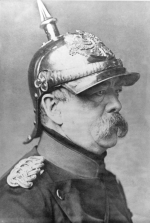
That means I was born in the year when Otto von Bismarck led Prussia and allied German states to victory over France and the unification of Germany. As a South African I can talk of my contemporaries Jan Smuts, Louis Botha and Sol Plaatje. On the international scene my contemporaries include Mahatma Gandhi, Franklin Roosevelt, Winston Churchill, Josef Stalin and Vladimir Lenin.
My last days may arrive when I am in my seventies, about the time the Allies defeat the fascists in World War II, or soon after. Should I survive another decade and live until my mid-eighties, I would see in a colour magazine or possibly on black-and-white TV how a young upstart called Elvis Presley shakes his leg like no decent man would have done in my day.
——————–
(Acknowledgement for the Bismarck photo: Bundesarchiv, Bild 183-R68588 / P. Loescher & Petsch / CC-BY-SA 3.0)
Imagine someone asks you to make a rather significant monetary contribution to a cause, and you answer, “I can’t really help you. I don’t make much money. It’s not what I do.”
“What do you mean making money is not what you do?” the person asks. “Everyone needs money!”
Not one to let a chance go by to point out a misconception, you confirm that of course most people need money, but that not everyone needs to make money. As examples you point to monks and nuns, the children of rich people, people who have inherited a lot of money, criminals who have stolen enough, and so on.
You explain that you do have a part-time job, but that you make just enough money to pay rent, buy food, pay the bills, and do something fun every now and then. Any extra money is saved so that you can afford to visit your family every year or two.
After going back and forth it might emerge that you do in fact try to make more money.
“Yes,” you admit. “That is so.”
You’re not stupid, you say. You are aware of the benefits of having more money than what you need to buy necessities and pay for necessary things. “So I try to make a little more money, but again, it’s not my first priority.”
“You don’t have children, do you?” the other person asks.
“No,” you reply. “For that I will indeed need a lot more money.”
“If making money is not your first priority, then what is?” the other person asks, by now visibly irritated.
“Like every other human being on this planet,” you start after striking an appropriate pose, “including the man or woman who lovingly raises a family, the man or woman who worships a god in great sincerity, and the man or woman who consumes large quantities of drugs or alcohol my first priority is to try and make my own life worth living. I have discovered that there are things that cost relatively little money that actually make me feel like my life is worth living, much more than was the case when I was merely trying to make as much money as possible and not much else.
“If by who I am and what I do I end up contributing to other people also being more convinced that their lives are worth living,” you add after a brief pause, “that is also good.
“But,” you say, circling back to the start of the conversation, “unfortunately I simply do not make enough money at the current moment to contribute much to this very noble cause.”