The school of unpleasant experiences

THURSDAY, 13 AUGUST 2015

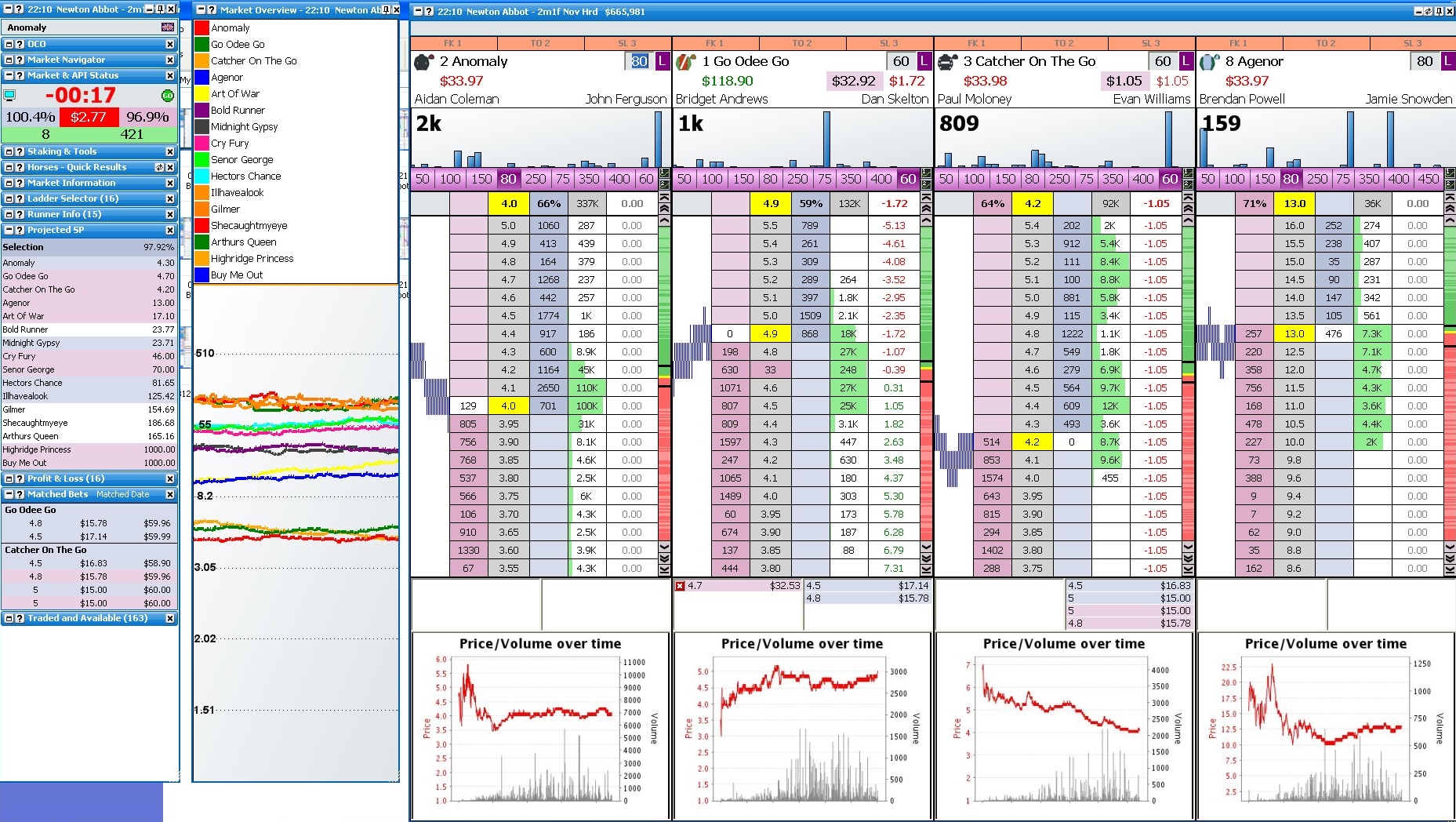
I am still learning how to earn my future bread and butter by speculating with prices on the world’s largest betting exchange – in my case mostly UK horse racing before the races start. I don’t want to give an account of how I am doing here and now. What I would like is to mention that I have discovered by now how I react to losses, and when something I expected to happen does not happen – with the result that I lose another few cents or dollars to someone else.

I find it interesting how difficult it can be for me to lose money – most of the time small, insignificant amounts. And then there is the hope, and the assumptions. The other day I heard someone say in a movie on TV: “I can take the pain, but the hope is killing me.” I am a pretty optimistic guy. I want to believe tomorrow will be better than today. When the first signal appears that things are looking good in a specific trading situation, my fist is already clenched and ready to shoot triumphantly into the air. Then it appears things just looked good at first glance. And my fist relaxes. My shoulders drop. If this happens a few times in one week, I once again contemplate giving up (I have to express it in a different way because talk of giving up can so easily become commonplace).

I can’t remember what my assumptions were when I started with this project, but I think I assumed it would take a month or so for my account to begin growing. Eventually I became more realistic and started talking about eighteen months to two years. On a smaller scale I frequently make the assumption that it is going better and better, and that I am getting closer to that elusive point of success. Then it escapes me again. And then the disappointment kicks in, again.

This, at the end of the day, is interesting – to the part of me who is interested in things of this nature, and less bothered by how much money I make … or don’t make. I would almost go so far as to suggest that this strong emotional reaction to losing, or to being wrong, or to being disappointed when I hoped for something better, is worth the money that I have spent on it so far.

FRIDAY, 21 AUGUST 2015

The difference between the ages of 30 and 44 for me is an extra decade and a couple of years to observe myself in situations, and with certain challenges, and to see where I am okay, and where my weak points are.

______________________

Important ideas – some of which are repeated

MONDAY, 22 JUNE 2015

A thought regularly occurs to me that we often possess the right knowledge, we know a lot of things we need to know, but we cannot always express what we know in the right words. The result is that what we know becomes blunted.

I believe this is one of the reasons why people respond so positively to writers or singers or public speakers when they succeed in expressing “that thing” in exactly the right way.

THURSDAY, 2 JULY 2015

My organic robot brain downloaded the instructions at some point that I have to work at least eight hours per day to justify my existence to others and to myself.

The alternative is that I need a lot of money because, as Robot Brain also understands it, rich people do not need to justify their existence – only peasants have to do it, and servants, slaves, and so forth.

FRIDAY, 24 JULY 2015

Success?

I am 44 years old and I can pay for my own dinner.

Nobody can accuse me of having unrealistic standards.

FRIDAY, 31 JULY 2015

Drumroll for an important insight: We often say, “But someone else has already said that” or “Someone else is already doing that.”

Fact is, not everyone heard when that other person said whatever they had said; not everyone has seen that particular movie or read that specific book. And even if people have heard what that man or woman had said, or if they have seen a certain movie or read a particular book, they may have forgotten about the lights that had come on in their heads!

We all forget things. This, at the end of the day, is why important things need to be repeated.

______________________

Play the right card while you still have time

TUESDAY, 19 MAY 2015

Seize every opportunity you get to be happy because in the blink of an eye it can all be over.

“Wait! I haven’t been happy enough!”

“Too late. Let’s go.”

“No, wait! Just give me one more day! C’mon, I had no warning!”

“Few people get any warning. Let’s go.”

“No! A few hours more … if I had known, I would have …”

“Do you really think you’re the first person to ask for more time? You’re done. Game over.”

“Okay, let me just quickly …”

“Don’t make me use the cattle prod …”

TUESDAY, 2 JUNE 2015

I am currently working on a few projects – four or five thematic collections of notes and pieces and new ideas that prompt me to say, maybe I’m just another pleb, just another schmuck whose life is not much different from the next person’s after all, and I am indeed wasting my time with my so-called writing.

On the other hand, there is a slim possibility that I have lived my adult life so far in a way that has given me a unique view of human existence and the lives we live, and that a combination of personality and tertiary education could make it possible for me to write something that would make someone else say: “I like the wording of this. It’s not really something that I haven’t thought of myself, but the way he talks about it makes it easier for me to organise my own thoughts.”

It is possible that there is nothing special about me or my writing, but I nevertheless choose to play the second card.

______________________

When optimism is a bad thing

[This text was originally written as a pre-race trading note. Despite my belief that I wasn’t going to get anything from the event, or deserved to get anything out of it, I couldn’t help extracting an insight from it.

Briefly, pre-race trading is about the sometimes fast-paced buying-and-selling of bets in the five to ten minutes prior to mostly British horse races. Some people make hundreds of pounds every day by trading thousands of pounds. My hope at this stage was to make a few dollars every night, which came down to only making a few cents per trade.

I use terms that will mean nothing to most people, but “profit” and “loss” and “didn’t do what I should have done” – like getting out of the market before the race starts – are actually the only ideas that matter.

The optimism part comes in where the pre-race trader sometimes believes it will be okay if he doesn’t exit before the race starts – when prices start jumping around wildly which sometimes ends in your favour, and other times ends with you paying much more than you were hoping for.]

WEDNESDAY, 22 APRIL 2015

The worst of the $20.99 loss because I didn’t want to hedge for a 3-tick loss pre-race is that I learned nothing from it that I hadn’t already known. I’ve been getting closer and closer to this exact thing happening over the last few weeks. I no longer exited thirty seconds before the start. I was unwilling to exit for a loss if I couldn’t understand why the price was coming in. This was inevitable. I was just lucky that it didn’t happen last week, or the week before that. I should stop everything. End of the road. […] Delete everything. Uninstall the software. Take a few weeks to work out what you’re going to do instead. And what makes it hardest is that things have been going generally well. A $20.99 loss is 175 times my average profit.

(I layed at 6.8 on a tight range a little over two minutes before the race was due to start. The price dropped one tick, two ticks … then it came back. $118 before I could scratch, dipped again, two ticks, three ticks … “Wait for in-play” … Suspend. Nightmare: Within three seconds the price is 4.8 … 4.5 … 4.2 … 3.8 … There’s opposition but the price is still coming in! $10.00 loss … $13.00 loss … agh! … It’s just one mile, and the price is still coming in! He’s just crossed 2.0! Maximum liability is $29.00! Agh! Hedge! Hedge! Hedge! Out at 1.74, and only because he was beaten at the last moment, otherwise my loss would have been almost $30.00.)

THURSDAY, 23 APRIL 2015

What can you say when you burn your fingers for the seventeenth time because you thought it would be okay to take a hot pot from the stove with your bare hands? And you know you weren’t absent-minded. You know you were not in a hurry. Despite having seen how ugly and how painful such burns can be, you took the risk. What can you say?

* * *

Misplaced optimism.

Optimism is usually a good thing, but speculative trading on any market is one example of many where optimism has no place.

More than that, optimism in some situations can be fatal.

A car rolls forward to a 200-metre deep abyss. “I’m sure the car will stop before it gets to the edge” is an example of misplaced optimism – optimism that can cost you your life.

Someone grabs you in a parking lot, throws a bag over your head and pushes you into a car. “It’ll be okay once we arrive somewhere,” your optimism kicks in. When you are tied to a chair an hour later in a dark room and you are slowly tortured to death, you know – you should have kicked and scratched and fought like a possessed cat to get out of that car. Your optimism was misplaced. Your optimism is going to cost you your life.

Fact: there are situations where there is no room for optimism.

Any form of financial trading is a situation where optimism has no place. Before you turn on your computer and make your first transaction, it is of utmost importance to take your cheerful “Optimism rules!” hat off your head and replace it with your black “Pessimism’s where it’s at!” or “I’m a miserable pessimist” or “Pessimists make it to another day” hat.

Remember: Optimism when you trade can cost you 175 times your average profit in one transaction.

______________________

The trifecta of adult life success

WEDNESDAY, 25 MARCH 2015

Here is the trifecta of adult life success, as I interpret the views of the community at large – that is, most adults in your immediate environment, and/or your friends and family, and/or most of the people on your so-called Facebook friend list:

1. At least two children – one could have been a lucky shot; a second proves it wasn’t

2. More money that you need for basic survival – it doesn’t matter if you inherited the money or if you won it with a scratch card

3. You do something interesting – can be your career, or anything else that is more or less a challenge

If these criteria are accepted, I know very few truly successful people. I almost always see myself as less successful than most of my contemporaries because we don’t have children, and because I only make a little more money than I need for my survival. But I know quite a few people with two children, not much money, and they don’t do anything interesting; also people with money, but they have only one child, and they also don’t do anything that I will regard as moderately interesting.

MONDAY, 6 APRIL 2015

To move this discussion one step away from mere campfire talk, it has to be mentioned that there are a few exceptions that may upset this formula.

There is the case of wealthy parents who do interesting work and who lead interesting lives, but one of their three children becomes a murderer, or a drug addict, or both.

There is the man or woman with money, who leads an interesting life, who has two or three children, but who still falls victim to a midlife crisis and say things like, “I wanted to do so much more at this stage of my life.”

And then there is the father of two children, who earns a lot of money and who, at least in his own opinion does interesting work, whose daughter is friends with the daughter of the CEO of an international conglomerate, who often goes abroad for interesting projects and who owns a villa in the south of France. “Why can’t Dad make more money so that we can also spend summers in France?” is the kind of request that would cause the man to occasionally doubt whether he really does as well as he sometimes thinks he does.

______________________