A history of negative beliefs and perceptions

SUNDAY, 2 DECEMBER 2018

What happens when you become aware of exactly how much it matters how you think of yourself and the life you lead, and to what degree you create your own reality – both positive and negative, and you then not only apply these beliefs to efforts to improve your own life by, for example, making more money, but you also apply it to one of your other great interests, namely political history?

* * *

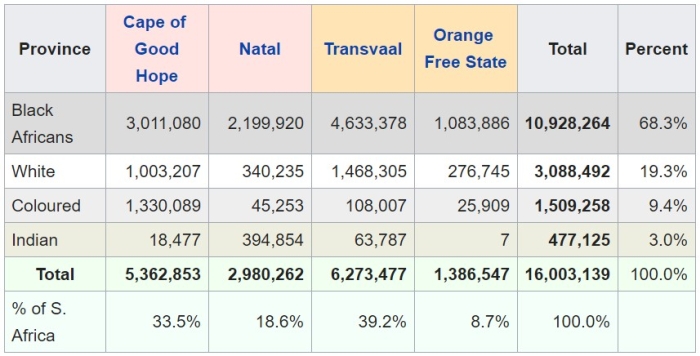
By 1960, seventy percent of the population of South Africa was black, about ten percent brown and Indian, and about twenty percent white. Black people, as well as coloured people and people of Indian descent, were deeply aware of the fact that they enjoyed fewer rights than the white population, and that they did not have similar opportunities as their white compatriots. Various campaigns were launched to put pressure on the government to rectify the situation.

Why did many of these efforts largely fail in those decades? Mainstream history books explain that the white government had access to better weapons, and better tools to suppress the black population, and the coloured and Indian populations, and to keep their aspirations under control.

I think another factor also played a role. I believe a critical percentage of adult black, brown and Indian populations fell for the confidence trick of white supremacy. It can even be said that they were trapped in a prison in which they themselves were the main players.

Again, one can quote Marcus Garvey who wrote: “Liberate the minds of men and ultimately you will liberate the bodies of men. […] We are going to emancipate ourselves from mental slavery, for though others may free the body, none but ourselves can free the mind.”

* * *

“Are you saying they were responsible for their own misery?” anyone who polices what people think and say to make sure it doesn’t violate the precepts of the prevailing dogma of our time may ask.

I just write down what is in my mind, I’ll reply. Other people can make their own conclusions according to their own beliefs.

* * *

Do people who would criticise me for this train of thought imply that black, coloured and Indian people in the fifties and sixties and seventies were not capable of creating more positive, more fulfilling lives? Were people like Nelson Mandela, Walter Sisulu and Oliver Tambo not evidence that it was possible? After all, they did not internalise the trick of white supremacy. That was why they were considered dangerous, and why the white government considered it so important to inhibit their movement and prescribe what they said to whom! Specifically, these three men, as well as many other black, coloured, and Indian men and women, confirmed that you are able to create your own reality, in which you can succeed despite opposition.

“But one of the three men you mentioned ended in exile, and the other two in prison for decades,” my opponent in such a debate would remind me.

It is true, I will respond, that what other people decide has an effect on your ability to steer your life in a particular direction. Mandela, Sisulu and Tambo ended up in exile or in prison because not enough other people thought like them. That they were not initially successful – or that it appeared as if they had failed for three decades, was not a rejection of the idea that you are able to create your own well-being and happiness. It simply proved that it matters if not enough people believe it. Not to mention what happens when a significant segment of the population believes that resources are limited, giving their support to a government that oppresses other segments of the population so that this group can get more for themselves.

The history of South Africa is a history of negative beliefs and negative perceptions about self, about other people, and about life, which inevitably leads to negative repercussions.

1960 Census

______________________

A return to religion – in a way

SUNDAY, 25 NOVEMBER 2018

This year may end up seeing my return to religion.

I have rediscovered “god” in a way – the incredibly powerful presence that punishes you if you don’t have a good relationship with “him”, but if you can make peace with “him” the world is your oyster.

Faith this time around is also practical. You are invited to think about it … and if you see that it makes sense, you can transform your life. If you don’t want to accept it, you won’t be condemned to hell at the end of your earthly existence, but your earthly existence may be sufficiently miserable to serve as your personal hell.

Of course, I speak here of the view that it matters how you think of yourself and your life, and about you relationship with money.

THURSDAY, 29 NOVEMBER 2018

Positive thoughts, developing a healthy mind and body as part of a process of creating a good life, a positive relationship with an ever-present force, the idea that this way of thinking is like a muscle that needs to be exercised regularly and strengthened … does it all ring a bell?

This morning I imagined how it would be if one had to manage this positive, creative approach to life as other people manage their commitment to Evangelical Christianity, or then as I approached it in my teens and early twenties. Examples include having to meditate for a few minutes every night before going to bed, and every morning after you get up, and maybe to read a page or two from a book on positive thinking or self-improvement. You may also need to make peace with money (definitely an important issue in my case), and start a new, positive relationship with it. (If you want to put an interesting spin on it, you can of course refer to it as Money, with a capital letter.) Your relationship with other people you come into contact with is also affected. Instead of reacting to other people’s negative stimuli, you decide to focus on the positive as far as possible, and not allow yourself to be drawn into someone else’s negative space. Lastly, it also includes – if you are fortunate – regular meetings with people who think and believe like you, to confirm and strengthen your outlook on and approach to life.

The fact is, you either drive through life with no specific outlook, purpose or vision, and simply respond to things people say and do, and to events that affect you, or you deliberately choose a particular view of life that enables you to function better in the community where you live, to do more with your life, and ultimately to be happier, and perhaps to even have a positive effect on other people’s lives. Some people choose institutionalised religion with centuries-old traditions. Other people choose to believe certain things about the functioning of the human body, and how the brain and personality work. (There are, of course, many people in both camps.)

Both the traditionally religious who take daily actions and think and communicate in a particular way, and the person who believes in positive thinking and constantly improving themselves, who also take certain actions on a daily basis, and who thinks and communicates in a certain way, would recognise something in the other – an attempt to live your life in a way that works better than just taking every day as it comes, until you expire.

______________________

Programming and discovery

WEDNESDAY, 28 NOVEMBER 2018

09:54

Someone says something on Twitter about the consequences of the way they grew up. I imagine some people would criticise the person for complaining instead of being grateful for what he got.

Then I realised: The person’s argument is not one of complaint, but of creative process.

Point 1. Accept you are programmable.

Point 2. Assume you were indeed programmed as a child and even as a young adult, and that this programming is a normal aspect of life amongst members of the same species (other animals do it too). Also, assume that as an adult you continued the process by internalising and confirming your earlier programming, even hardening it.

Point 3. Eventually you confront your programming, and you identify “mistakes” – things you accepted as truths that are not in fact truths.

Point 4. You start the process of programming yourself for the world and the environment where you are living your daily existence.

12:38

You discover yourself as you get older. But remember: Your parents – the primary programmers in most people’s lives – also discovered you as you got older.

You were not born with an instruction manual: “Don’t scare little Jimmy with something slippery. He’ll develop a lifelong phobia …”

Your parents couldn’t wait to get to know you before they started programming you with basic beliefs, preferences, dislikes, and so on. Of course they were going to make mistakes! Time was not on their side. If they had left you a blank canvas until they discovered your unique composition, or until they knew exactly what programming you would need to function optimally as an adult, you would be a bigger screw-up than the one you are today because they had made some mistakes.

______________________

The terrifying truth about easier money

SATURDAY, 24 NOVEMBER 2018

I just read an article on currency trading. It’s about a strategy where you spend a few minutes every day looking at the markets, and with just one or two transactions you can produce enough profit to live on. After a few minutes I couldn’t take it anymore: “Hundreds of points profit a month?! And you just look at the market a few times a day?! Could it be that there are people who make money so easily?!

Remember: This eruption came after I recently realised that I had been carrying a particular blueprint in my head for years that dictated it had to be difficult to make money, that I even had to expect to struggle. Also remember that I have confronted this programming, and have already started deactivating it.

The truth is, the idea that some people make huge amounts of money without having to work very hard (to put it mildly), hits you between the eyebrows. You don’t want to hear it. You hear a voice that murmurs from deep inside you, “No … it can’t be …” You think of farm workers hunched over working in the sun for decades, of factory workers doing boring work for decades, of office workers who feel like they’re going to go mad after five years of listening to the rumble of the air conditioning system and the chattering of people sitting in the cubicle next to them trying to sell something on the phone … and then they hunker down and do it for another two or three decades.

And yet we all know there are people who generate millions through the buying and selling of products or property, or businesses or companies. There are entertainers who make millions by singing songs that other people write for them. And there are sports stars who earn loads of cash by posing with a razor for the camera and smiling broadly (and then shaving with a better quality razor).

I think the problem is that most people write these examples off as exceptions to the rule. I think most people expect ordinary people like them to earn their bread and butter in the sweat of their brow (or with an office’s air-conditioning system rumbling in the background). And because most people expect this to be the reality, they take actions to create and maintain this reality.

An cynical reader might ask, “What is ‘easy’?”

Of course, people’s ideas about what is easy differ. What I find easy is perhaps impossible for someone else, and vice versa. Many people also associate easy money with criminal activity.

If you’re sceptical about the possibility of making more money than you are making right now by working fewer hours, I suggest the following test question: Are you prepared to put $1000 on the table in a bet that there are no “ordinary” people who channel large amounts of money to their bank accounts in legal ways that you won’t regard as hard labour? Are you willing to take such a bet? If not, your position that it must be difficult to make money, that you even have to struggle, that the norm is that you have to spend at least forty hours a week “at work”, is not the real truth, but is simply how you were programmed. And how you choose to keep believing, because the alternative might require some serious introspection on your part.

______________________

Becoming who I have always been

THURSDAY, 8 NOVEMBER 2018

Not making enough money, or struggling financially, is like being stuck in a small town your whole life because you don’t think you’ll be able to make it anywhere else. You were born in this town. You know everyone and everyone knows you. You know all the streets, all the restaurants, the best places to get fresh fruit and vegetables, the best swimming spots, the best place to look at the stars. Still, you’ve always longed to do more with your life. You’ve always wanted to experience more than just this small town, and to meet other people – different people, maybe even more interesting people; people with different points of view and different opinions. You’ve even thought about learning other languages. You’re often frustrated, sometimes lonely, often unhappy, but everyone is convinced you won’t make it anywhere else. (Look at so-and-so who tried, and look at where they ended up, people would always say.) So, you keep your dreams to yourself and slug it out to the end.

Meantime, the world is full of people who come from small towns, who had dreams, who pursued their dreams, and who believed that they, too, can make it in places bigger than the small towns where they were born and raised. They believed that not only would they be okay, but that they would be able to thrive in a bigger world with fewer limitations and more options – where they could experience more, learn more, and grow into the fullest version of themselves.

* * *

I smoked cigarettes for fourteen years. I thought of myself as a smoker. At social events, I knew who the other smokers were, and enjoyed puffing tobacco with them outside on the balcony or on the veranda. Then came the point when I got serious about quitting (or more serious than previous times). Within a matter of months I started thinking of myself as a healthy guy – a non-smoker. After a few years, I didn’t even smoke one or two cigarettes on occasion outside a restaurant. I had completely outgrown the smoker identity. Smoking was something I did years earlier, but from which I had moved on.

The same with views about money and struggling to make money. For a long time this was part of my identity. I saw myself as someone struggling to make money. I saw myself as someone who would have done better in a world where money wasn’t such a big factor. Other people also knew me as someone who never had much money – if they couldn’t guess, I probably said something that drove the point home.

Now I know that this identity of struggler-with-money was not the truth either. I was never by nature a smoker; it was just a bad habit I had for a few years. Similarly, it is not my truth that I have to struggle to make money. That I struggled with it for years had simply been the result of unintended bad conditioning, lack of proper education about money (for which I myself take responsibility because I have been an adult for almost thirty years), and – like cigarettes – a few bad habits.

* * *

When you are young, ideas about money and about making money sometimes come across as universal; that is, you assume that you share the same ideas and beliefs with your schoolmates and cousins and other people of the same age in your neighbourhood.

What you only realise years later is that beliefs about money, your relationship with money, how it works to earn and accumulate and invest or play with money, even how you spend it, were specific to you, and maybe your siblings. There is a good chance that your schoolmates and friends and cousins of about the same age, and other children in the neighbourhood, had a totally different education about money and related matters.

Of course, you get extended families, or neighbourhoods or communities where there is a degree of consistency regarding what adults teach their children about personal finance. Nonetheless, your relationship with money, and what you teach your children, or what you learned from your parents, cannot as easily be defined as religion or politics or culture, and in many cases the lessons are much more subtle. It is therefore easy to be totally unaware as a child of the effect it has on your development, or as a parent to be aware of what you teach your children.

* * *

A child grows up in a house where he is taught to dance and sing for his bread and butter. In fact, he is somewhat of bashful fellow, and he doesn’t enjoy it at all. It’s not who he is. The stage is not his natural domain. After many years he discovers that he would rather design houses. One can almost say that he is a designer by nature.

For me, the condition of worrying about money is like the guy who is seriously uncomfortable on stage. Being worried about money is not my truth. It doesn’t come naturally to me. It pushes up from inside and gets stuck in my throat. One can almost say that I am by nature a wealthy man who never has to be concerned about whether he has enough money.

What I do now is to confront these negative views and replace them with positive views. The end of the process is that I will be who I have always been deep inside but could not express. So, I am not becoming a new person. I’m just becoming who I’ve always been.

SUNDAY, 18 NOVEMBER 2018

It is said that you have to go out of your comfort zone if you want to succeed. For me, with making money, it was the opposite. I believed money was only to be found outside my comfort zone – if something was easy, or pleasant, it could as a matter of course not work. Something had to be difficult, unpleasant, and boring. Then, and only then, did I stand a chance.

______________________