On “Hearts” and life

MONDAY, 18 JUNE 2001

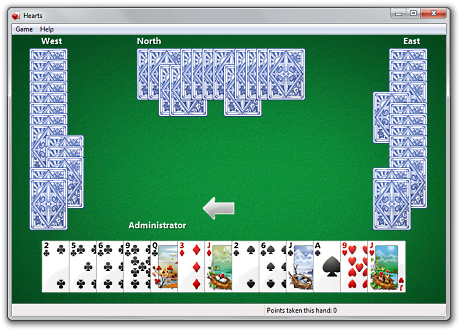
Microsoft Hearts in Windows 7

My strategy for the card game “Hearts” is on the face of it inconsistent with the goal of the game. It looks as if I am heading for self-destruction – just for the sake of entertaining myself while the other players are playing a serious game. By the time the others realise that I am winning a game in which they did not see me as a serious competitor it’s too late. Their attempts to save their positions are already doomed, and I’m on the way to a brilliant victory, achieved in an unorthodox manner.

However, it should be noted that I do not follow this unconventional strategy with each round. Once I see I am not going to win a specific round playing my way, I change my strategy. So, I am pragmatic enough not to defeat my real purpose for the sake of being different.

This approach to the game takes guts, and almost excessive levels of confidence. You also have to accept that you will lose from time to time, and that such results should be treated with as much grace as a victory.

At the end it can be said that a victory achieved in your own way and against the expectations of the other players is much more fulfilling than merely winning the game according to both the spoken and unspoken rules and conventions.

If, however, you lose time and again by following your own unorthodox methods, it is usually a good idea to reconsider your primary goal, as well as your methods. The illusion of self-destruction is after all – and this should never be forgotten – supposed to be only an illusion.

______________________

How the forces dance

FRIDAY, 1 JUNE 2001

That everything revolves around power is one of the most important things I’ve learned on my path to adulthood. This truth applies not only to the political and economic fields, it is just as valid in the arena of personal relationships.

Any person who has ever been lucky enough – or unlucky, as is sometimes the case – to have been in an intimate relationship could tell you that both parties always knew where they stood in the balance of power. In the ideal relationship both parties are of course equal, even if one is sometimes in a better emotional state than the other, and therefore better able to dictate matters for the moment. But the fact that the party in better mood changes every now and then confirms the basic equality of the two parties.

This principle also applies to friendships. There may be times when one friend is more in control of a situation, and more confident of him- or herself. In such cases, the other friend almost instinctively takes the submissive position. These roles may change as soon as the topic of discussion changes, or when a situation develops in which one person is more comfortable, or that he can approach with more confidence.

The same phenomenon also manifests in subtle ways in social intercourse between strangers. When two people meet for the first time, say at a barbecue or at a drinking and dancing event, the brain undertakes a speedy profiling process. Facts are sought and arranged in a preliminary understanding of the balance of power. Is the person friend or foe? Is he cool, or is he a loser? Is she someone whose name I should remember, or should I give her a limp handshake while I look over her shoulder for someone else who could pique my interest?

Depending on the initial answers to these questions, we decide where we stand with the stranger in question. If the person is considered a non-threatening potential friend who gives the impression that he or she knows what words to use in what context, then the next set of questions is sent to the Supreme Organ: Should I treat him/her as an equal, or as someone I wouldn’t mind dragging along as a fan? Or, should I try my best to win this person’s favour because, a) the person knows more than I do, b) has more experience than me, c) has something that I want, or d) I regard the person as my superior for all three reasons, and a few additional ones?

You might think that this whole thought process takes up most of a minute, but in many cases these questions have already been answered by the time the handshake is done, or the heads have stopped nodding. The factors that determine the answers include appearance, the intensity of a smile, the enthusiasm or lack thereof when the other person is greeted, people you or the other person are with when you are introduced to each other, or any information that the person knew about you before they met you, or information you had about them.

Sometimes it is possible that an initial weak view of you changes as soon as the other person become privy to certain information about you. If the person finds out, for example, that despite your eccentric appearance, you are, let’s just say, financially very comfortable, you might just find an immediate change in attitude on your return from the bathroom.

Of course, the opposite can also happen. You may reckon you have left a lasting impression with the fine synchronisation between appearance and fantastic myths you have spread about yourself, but by the third time you see someone who initially fawned over you, you might find to your dismay that the person has since found a stronger figure to cosy up to. Or maybe you leaned too heavily on your anecdote about the time when you and a member of the dethroned Burmese royal family had fled through the jungle of Vietnam, only to find you are in Thailand and that he held you responsible for the fact that he had malaria. “Since when does everyone have stories like these?” you’ll ask yourself as you search the room for a new group of people to impress.

It is, unfortunately, not only the untouchables of India who are struggling with a caste system. All communities have hierarchies and classes that crisscross each other. Everyone, from the richest to the poorest, from the hippest accountant to the most boring pop star have to cope with keeping up with what defines their place on the power hierarchy in the environments in which they display themselves.

Someone should invent a mist that can be sprayed over a social gathering that would reveal the true opinions and levels of respect that people have for those around them. A few secret admirers might be exposed, but the chances are much better that some bloated egos will be pricked into nothingness.

______________________

Notes and letters from March to May 2001

Junk food breakfast, and meaning in life

“Work, marriage? Hmm … one needs money, true. One needs companionship, and children sometimes compensate people for not having anything else to give meaning to their lives. All these things have been tested over time and are regarded as universal truths.

Nevertheless, there is more than one way to satisfy the need for money other than a life-sucking job; more than one way to satisfy the need for companionship other than marriage; and more than one way to satisfy the need to experience meaning in your life other than having children.

Take me for example, I’m trying to make it as a Sermoner, and although it doesn’t pay the rent, I do get a kick out of preaching to other people. As for companionship and children, well … it’s not a perfect world. McDonald’s sell a decent breakfast, though. Have you tried that?”

~ From an email to a friend (9 March 2001)

Always wandering?

I can get away with presenting myself as one of “them” – by living a somewhat unconventional but nonetheless middle-class existence. To some extent I want such a life. But there are always other lives to be lived. And I will always have one eye on the type of existence I’m living now.

I don’t think I will ever be able to truly live a conventional middle-class life, even if it is financially within my reach – and these days you don’t need to live in your own country to enjoy this kind of life. I will never be able to lead such an existence in a motivated, dedicated way. I will always be peering over the shoulders of my neighbours at the people who are still wandering, uncertain of what it is they have to or want to do, on roads that cannot exactly be called the “main road”.

~ From the Purple Notebook

… Or am I going to reach a point?

1) I think I’m going to reach a point sooner or later where I’d say, “This!” … “This one, not that one!” … “This way, not that way!” … “Here – not there.”

2) I might also reach a point when I’d start reacting against the idea of being a citizen of the Greater World; a time when I would retreat to a smaller world where fewer things matter – where it will be easier to make decisions.

3) I always believe there are things that I’m supposed to do, and then there are the things that I actually do every day. I am always convinced that what I’m doing is never as important as what I’m supposed to do; that I repeatedly fail to do the more important and more meaningful things.

4) “Don’t you want more?”

“More ice cream?”

“No, more everything! Don’t you want to do something important? Don’t you want the whole world to know who you are?”

“[No.] I already have everything I need.”

~ Note from the Light Brown Notebook (The dialogue is from a movie of which I only saw a small part on TV.)

The challenge: DARE to enter, like John the Baptist / the wilderness alone

~ From Icarus journal, Monday, 9 April 2001

Thought from “Exile, part six”

To write as much as possible affects who I am. The last thing I want is the cheap insult of just talking about what I want to do. I want to lay something on the table through which I could say, “This is what I’ve been doing with my life recently.” It affects my dignity. It affects my self-respect. It affects other people’s perceptions of me and how I want them to see me. And it affects my future as someone who managed to do what I wanted to do, to not be yet another victim of “That’s just how things work,” and “We all had dreams when we were young.”

(Wednesday, 11 April 2001)

______________________

The beautiful world

MONDAY, 30 APRIL 2001

A friend of mine recently mentioned the ambition of working four days per week, and work that’s getting tedious. That she was frustrated with what she has to do for money, is putting it mildly. I could only respond in one way. “You’re a creative person!” I told her. “How many hours per day do you spend making something, creating something? How many hours per week?”

We – the somewhat educated inhabitants of industrialised countries – live in a world where a large percentage of the population is required to provide certain services to maintain the economic status quo. Sometimes it takes sacrifice, on a daily basis, to do the types of work required for this purpose.

One of the sacrifices many people make is their creativity, to be connected with their true nature – to be creative. Of course, there are professions where creativity is required, and a privileged minority fills these positions. Most other workers of the First World order, as we know it, must ignore their inherent need to be creative – at least during “working hours”.

Because we don’t live in totalitarian states where people are forced to abandon their freedom, they must be persuaded by other means. Why on earth would people willingly give up free expression of their creative needs for forty to sixty of the best hours of the week? For “Good Money”, of course! For the opportunity to belong to the “Beautiful World”! To look “beautiful” in this world is to look expensive. In order to be admired as one of the “beautiful people” you must fill your life with “beautiful things” – which, as we all know, means you’re probably not going to pick it up at the local Hospice shop up for a few dollars.

“Don’t you consider a Ferrari to be beautiful?” someone might ask. “Wouldn’t you want one?”

Of course! Is a Gibson Les Paul electric guitar of $600 not a more attractive and higher quality instrument than a Fender replica of a hundred? Anyone will be able to see and hear the difference. But we have to ask ourselves how much we sacrifice to be owners of these “beautiful things”.

A cursory glance will bring home the impression that most of us are willing to sacrifice too much. One of the sacred cows we unceremoniously throw on the altar of the Beautiful World is our ability to be creative, to create things out of raw material. For it is true that it requires a lot of time! But most of the time we are too busy making money with work we would certainly not have spent forty-plus hours per week on were it not for the financial compensation, or we are trying to soothe away our headaches after work, or blowing our Good Money. But the fact that we choose not to be creative does not eliminate the innate desire to create!

Unless we put in some effort to satisfy our creative needs in a sustainable way – with the exception of paid creative work, we fill the void by spending the money we earn on “beautiful” stuff to make ourselves feel a little better about ourselves. If that doesn’t work, we justify the choices we make by pointing out that we are “adults”, that we have a better understanding of the so-called real world than that artist who makes no money. And we laugh so much louder for silly jokes in our two thousand dollar outfits than for something that’s genuinely funny, but it might damage your carefully assembled persona to show appreciation for it. And it’s much easier to give someone a dirty look when he asks, “Wait a minute, what exactly are we doing here?” when you, who don’t have an answer either, sparkle with pearls, and your new Italian shoes glow in the light emanating from expensive boutiques when you trot down the street on your way to yet another purchase.

But what value do pearls and expensive watches and Italian shoes have when you realise, sometime during your forties or fifties, that, despite your earlier dreams and ambitions, you walked straight into that old trap that is set for all children of the middle class? Then you buy a Gibson Les Paul for … $600? “No wait, give me the one for 900, I’ve got a lot of catching up to do!”

But you realise it might be too late. You realise you have spent your life buying “nice things” instead of creating beautiful things. You have become a consumer; you have given yourself over to the disproportionate consumption of the results of other people’s decision to not also deny their creative nature.

It is necessary to point out that I don’t want to be faithful to my creative nature, but when it comes to paying up, the guy who slaves away in an office for ten hours every day has to pay for my steak and beer. I am very interested in money, and preferably lots of it. But my motivation is that having money will allow me to become even less subservient to the conventions of the Beautiful People; to establish a lifestyle recognisable as a good life, without denying what I consider being a central aspect of human nature.

What I want – to express it somewhat differently – is for the “beautiful people” to swallow their untested arguments with expensive French wine for which I’ll foot the bill.

How to be creative and have the ability to afford expensive drinks for your distinguished guests? I can’t provide an answer that will apply to everyone, but I believe too many people shy away from even the mere possibility. Or they consider the “reality” where they have to sacrifice creativity for money as so immutable that they are afraid they will be regarded as naïve, as “idealists” (such a dirty word in certain circles), if they propose something, however modest, that is against the accepted dogma of their “real world”.

People call me an idealist, and I plead guilty. I am, indeed, stubborn in my idealism. Why? Because the alternative is not nearly good enough or beautiful enough to persuade me to deny my own nature.

———————-

[Reading between the lines it becomes clear that it’s still important for the writer to convince the “beautiful people” of his views, not only in his own world of cheap beer and garlic bread, but in the type of environment where “expensive French wine” is expected by the “distinguished guests”. Perhaps a case of preaching to the unconverted in their own world?]

______________________

I am not the master of this world

WEDNESDAY, 21 MARCH 2001

I feel somewhat confused at the moment.

For the record, I think it’s stupid that there is this expectation that everyone should know what is important to them and what they want out of life by the time they finish high school, and at the latest by the time they graduate from college. And if what they want to do, what is important to them, and what they want from life, do not correspond with what usually brings sufficient financial rewards, they should know how they are going to reconcile what they want to do with the world they live in – where everyone has to bring their pound of flesh to the table in monotonous regularity.

Citizens of the establishment hope – and expect – that everyone who graduates from the Schools of Middle-Class Education and Culture will take their places with full conviction so that an orderly and civil society can continue to be orderly and civilised. By this time, however, the Sages of the current incarnation of Civilised Society know that a certain percentage of middle-class candidates will search for paths that do not quite match what has been laid out for them. The Sages also know that most roads lead to Rome – not everyone needs to follow a conventional career to contribute their share to the maintenance and ultimate evolution of this society. And for those who insist on still not making a contribution, there’s enough space in prisons, or in the streets, or in shelters for the homeless.

Since I have never felt strongly about a life in prison or on the street, I’m also trying to find my way to Rome.

“Where’s the confusion then?” you may ask.

I would have been okay on my own, and I know what path I can take to get where I need to go – and the road even goes through the type of landscape from which one can derive inspiration every now and then. But deeply-rooted needs that ensured the existence of a million generations dictate that I must find someone with whom I can share the road. And, as we all know, the next generation starts arriving soon after, whether you have marked out your territory or not.

Confused I therefore am, because – do I want my children to have blond hair and Chinese names, or will I prefer for their mother’s language to be the same familiar sounds with which I grew up? And if not here, then where … and then what should I do to put food on the table?! And big sister wants a lawnmower, and little brother wants a pair of high heels! And my wife wants to buy more magazines?! And all I want to do is write … and good grief, here comes another one! When did this happen? I hardly have time to shave! I don’t think this Babylon was ever meant for me … but now it’s too late because they’re downsizing again! And I’m almost forty and all I ever wanted to do was … but then suddenly I didn’t want to be alone anymore! And I was still stuck on an island in the Far East and I thought the grandparents would also like to see their grandchildren once in a while! And then I had no choice … I had to roll up my bedding and start walking.

I am not the master of this world. Thus are the rules, thus is the game.

______________________