Productivity and the lie

MONDAY, 20 OCTOBER 2003

The primary motivations behind the choices and actions that define my daily life are, as I mentioned earlier, the concepts of PRODUCTIVE USE OF LIFE WHILE IT FLOWS IN YOUR VEINS and an accompanying AVERSION TO THE LIE.

Many will want to propagate the idea that to make as much money as you can is a beautiful example of PRODUCTIVE USE. I believe it only qualifies as such if you take actions with the money that will lead to significant improvement in your own life and preferably also the lives of other people.

Just making a lot of money and then focusing on pleasure and entertainment is by definition a waste of LIFE WHILE IT FLOWS IN YOUR VEINS. It can also, on a certain level, and as the result of an argument I am not going to make right now, be seen as a LIE.

______________________

One/zero, and why one is better

SUNDAY, 12 OCTOBER 2003

Sometimes someone makes a choice, and it can only be described as the worse of, let’s say two options. With regard to this person’s decision, I also have a choice: to try and understand why the person made a particular choice, or not to try and understand.

If I manage to understand why someone made the worst of two choices and explain it to a third party, the latter may be tempted to say, “But that’s not an excuse,” and that I am defending that person.

My answer is that just because I understand why someone made a bad choice doesn’t suddenly make the choice less bad. A bad choice is a bad choice, whether you understand what motivated the person or not. But I also believe that the choice to not want to understand why someone made a bad choice is also the worst of two options.

______________________

Storming ahead with a burning violin

SATURDAY, 11 OCTOBER 2003

There’s a popular saying that says we start dying the moment we’re born. Our cells start ageing as they’re growing, and even though damaged cells are, up to a point, nurtured back to full function, and destroyed cells replaced, the rate is never adequate to keep us alive forever. Then there’s the fact that our lives could be terminated by unnatural causes as soon as we venture out of our cots. Can anyone be blamed for having severe existential anxieties every time they go outside?

A few years ago, in that glorious year right when I was supposed to join mainstream adult life, I was fortunate enough to watch a classic epic on my borrowed black-and-white TV. I had never been keen on cowboy or outlaw movies, but this movie gave me a particular perspective on life, and an attitude that has proven to be most useful.

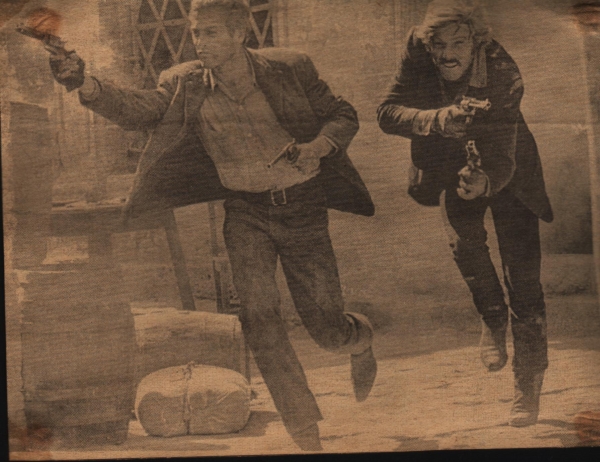
The movie, Butch Cassidy and the Sundance Kid, tells the story of two outlaws in the Old West. After robbing their way into trouble, they make their way to South America. By the end, the two bandits are held up in a small town in rural Bolivia by what they assumed were just a number of local deputies, unaware of a platoon of soldiers who also happened to be in the neighbourhood. Butch and the Kid are sitting in a room, their backs against a wall, discussing the chances of them getting out alive. Surrounded by the local militia, oblivious of dozens of soldiers also taking position, they calculate their chances to be slim. They would try, nevertheless, they decide. Outside, on the walls of the town, surrounding them from every possible side and angle, dozens of loaded barrels are awaiting their attempt. They check their guns, exchange a few last words, and emerge dodging and ducking hundreds of bullets. Although it is merely suggested by skilful direction, everyone knows the only possible outcome: They went down, but – with all guns blazing.

As I was watching the credits, mesmerised by the profound implication for my own life, I recalled seeing a screenshot in the newspaper that advertised the movie on TV that night. I located the newspaper, cut the picture out with a pair of dull scissors, and decided to make it a permanent and prominent fixture of every place I would henceforth inhabit. It was stuck to the bathroom door in the council flat I shared with my younger sister, to a closet door in South Korea, and displayed on more than one wall after I had returned to South Africa. It was the first picture I pinned to my living room wall when I got to Taiwan, and at this very moment it is pasted next to the front door of my current apartment, lest I forget where I’m coming from, or where I’m heading.

It has become the closest to a personal dictum, a philosophy of life other than “live and let live” that I can be content with.

Entering my living room this afternoon after Chinese class, the picture once again drew my attention. I had been thinking of my recent plans of leaving this island – an important train of thought that usually takes precedence over any other truckload of ideas, but the picture distracted me. I thought about how the picture explained what I have been doing this past decade, and especially during my time in Taiwan. My ongoing attempts at keeping myself busy are my own valiant way of going down with all my guns blazing. It’s not exactly heroic or brave, but it is my way of saying, “If we are going down no matter what, then I’d rather go down keeping myself busy to the final exhalation.”

It did occur to me though that my version of this dictum, and my attitude to life on earth might be a tad defeatist, perhaps even a little morbid, and embarrassingly boring. “Is there no place for some mindless entertainment?” I asked myself. I stared out the kitchen window for a second, and then it came to me: Nero playing the violin while Rome was burning. He – or at least the mythical Nero – ignored the horrible facts on the ground, so to speak, and instead amused himself with some musical distraction.

A lot may be said about this attitude as well, but it does have a certain panache, a degree of defiant flamboyance. To indulge in casual entertainment in the current day and age is not dissimilar to Nero’s drunken behaviour while flames were licking the marble pillars of his city. Watching a soap opera while people die of hunger may not qualify as flamboyant defiance in many people’s minds, but that doesn’t mean there is no justification for having fun.

We will all eventually die, our natural lives unavoidably reaching its conclusion. Going down with all guns blazing, whatever the substance of that for each person embracing this dictum, is one way of going. If you could have yourself some fun while you’re at it, then so much better.

Butch and The Kid stormed into an avalanche of a thousand bullets, their own guns firing away until silence fell, until their lifeless fingers slipped from the triggers. Nero tried to silence the screams of burning citizens by plucking at his violin. I do my household chores, learn a few Chinese characters, write the odd line of poetry, fix my bicycle when necessary, paint my walls and doors different varieties of eggshell white, and plan my repatriation from exile. And I’m pretty sure if I look for it hard enough I’ll be able to once again find that middle “C” on my cheap electronic keyboard.

______________________

On the next generation: Parenthood

TUESDAY, 7 OCTOBER 2003

One of the most prominent ideals of middle-class culture is GOOD PARENTING. According to the criteria of GOOD PARENTING parents justify their choices in life. It is also according to these criteria they judge the successes or failures of other parents. It is, finally, according to these criteria that I have disqualified myself from parenthood – at least for the immediate future.

One of the fundamentals of GOOD PARENTING is To Give Your Children The Best You Possibly Can. It is about this principle that I want to make a few remarks.

To give your children the best you can, may have consequences unforeseen, even to parents raising their offspring with the best of intentions.

One of these consequences may be that young adults who were raised by parents who provided in all their needs, who gave them abundant opportunities to develop their interests, and whose personality developed in a protective environment, increasingly become conservative, self-centred and selfish adults when confronted with a tougher reality than the one in which they grew up. This reaction may also manifest in calculated support for “the way things are” – the status quo – that had given them an edge in life without them having done much to deserve it. In a similar vein, they will also support all social, political and economic policies that entrench their position, and give a cold shoulder to those considerably less fortunate. They may even go so far as to call these people who were given less, “lazy”.

Another possibility in the case of a person whose luck of the draw included the benefits of the aforementioned background is that they will turn ashamed and embarrassed to people less fortunate than themselves. They may explain it as something they owe society because they “had it so easy, while others had it so hard”. They may even be unsure about what their chances of survival would have been, had they not grown up in an environment where all their needs were provided for, and where their interests and personality could develop without the interference of too much pain and unfulfilled desires.

My advice to parents is to, indeed, give their children the best they can, to teach them the value of responsibility, and to support their interests within reasonable financial limits. Furthermore, parents should be facilitators of the process that will allow their children to develop a self-esteem based on ability and merit, and not just on membership of a certain stratum of society.

Children should be aware of the suffering of others; that, and their own more privileged situation (if that is the case) should be explained to them in a way that will provide them with an incentive to develop a sense of responsibility towards their fellow human beings – including people in more impaired socio-economic conditions, as well as members of their own community.

Parents should teach their children the values of faith in their fellow human being, honesty, dignity, responsibility for others, and responsibility for their own actions. These values should not only be taught in words but in the actions and conduct of the parents towards their children, and towards others. Children should be made aware of the result of both love and hate, and should be taught through words, behaviour and actions to choose love. Parents should also cultivate in their children an attitude of open-mindedness and tolerance towards other people.

Children should be taught the value of principles, and to maintain these principles even if they sometimes have to stand alone. Children should be taught to believe in themselves and their abilities, by parents who believe in their children. Children should be taught that mistakes are sometimes a necessary part of life and that they must learn from their mistakes as adults must also do.

Children should be nurtured, cared for and protected in ways that would increase the likelihood that they would become adults who will love rather than hate, who will take responsibility even when others look away, and who will protect the vulnerable against agents of destruction. Children should be nurtured as miracles of life, so that they can become adults who will maintain and protect life, and all that is good.

Finally, it is also important that children should be made aware, in a reasonable manner and at the appropriate time, of the possibility that they, too, might have to endure disappointment, pain and suffering. It will also not be inappropriate to teach them that death is inevitable; that it is the fate of all forms of life to reach the end of a physical existence.

However, it must always be emphasised that, although all forms of life reach an end, there is a condition that precedes death. Children should be taught that this state of LIFE should be cherished, greatly appreciated, and supported to the last breath.

______________________

On the next generation: Introduction

[A sometimes foul-mouthed rant about wanting to become a father – or not.]

SUNDAY, 5 OCTOBER 2003

I should not have children. Not now, anyway. I’m too tense, too wound up about life. It took me ten years just to say: “Okay, I think I’ve got it sorted out. I now have the recipe! Now I just need to bake the cake and hope others find it edible. Or I hope at least I reckon it tastes okay, otherwise I’d have to try again.”

How do I expect to be a father figure to children?! An uncle to nephews and nieces, yes. I’ll be a good uncle, the kind who knows and understand things my brother’s-in-law may not know or understand. But I’m afraid I’ll be the type of father of whom my own son will say to his friend: “I wish my father was more like yours. My father is so anxious about everything. I hope I don’t turn out like him one day.”

My problem is, after all these years, I still look at myself in a middle-class mirror. Still! After all these years! And in this mirror I still find myself too insubstantial! “Already 32 … not married … nothing on the horizon … no house or car … still writing the same pieces over and over since you were 23.” Fuck everyone! Fuck the middle-class world that I still drag around my neck like a burning tyre! For once look at yourself in your own mirror and judge yourself according to your own criteria, not according to what you assume other people’s criteria are!

But it all falls flat because I shuffle embarrassedly through middle-class homes in my plastic sandals, because I don’t think I’m allowed to step on their carpets in better quality shoes! And I feel ashamed when I stand in their kitchens because I wish I also had a microwave oven!

Do I think it’s time to clear my throat and announce, “Ladies and gentlemen, you’re pissing against the wrong tree. I’m not one of you”?

Or am I? Is it not true that I also want to marry and have children at some point? But how can I reconcile that with my current ambitions, and with my anxiety about life and death?

It is indeed time that I crawl from my class closet and announce that a few things should be made clear, and fuck everyone basically, and that’s how it is, how it’s always been, and how it’s going to be tomorrow and next year too.

MONDAY, 6 OCTOBER 2003

Does what I said last night mean that I would prefer to be on my own for the rest of my earthly existence, or that I don’t want to make ten times more money than I presently do? No, to want someone in your life is essential for survival in this world, and that large amounts of capital can be a useful resource cannot be ignored.

Particularly good reasons can be pointed out why I should continue to strive for companionship with another person and for financial independence. Striving towards these things so I can say to my contemporaries, “Look friends, I am now one of you!” is, however, not one of the reasons I’ll be pointing to. If the friends don’t want to play, they can go to hell.

TUESDAY, 7 OCTOBER 2003

Because I want to have children. That is why I still give weight to people’s criticism and negative opinions about me that would otherwise not matter. After all the left-wing politics, after all the talk about creative and personal freedom, there is one thing I can’t fit into my current lifestyle: the ideal of a Good Father who gives his children the best he possibly can, and who sometimes sacrifices his own preferences and ambitions for his children.

Why would the possibility of having my own children one day make me vulnerable to criticism regarding my choice of a lifestyle? Because, to be a Good Dad, I need money. I firmly believe that a father who can’t afford to look after his children will always have a problem looking his children, his wife, his neighbours, his friends, relatives, other people in the community with whom he differs in many respects, and finally himself in the eyes.

Am I good enough to be a father figure to children? I have always believed I am, or could be one day, because I reckon my experience as a teacher has shown that I understand children to a certain extent, and that I get along with them well enough. I also know from experience that I can be strict when I need to be strict, conservative when I need to be conservative, and open-minded, tolerant and patient enough to let children be children.

The problem is, I suffer too much under my own fears and insecurities. I also have no record to show that I can carry the financial responsibility of taking care of a family – or at least to make a reasonable contribution with a salary-earning spouse. This leads me to only one conclusion: I don’t qualify to be a father figure at this stage of my life.

* * *

It does strike me though: Many of the things I’m unsure of have to do with the highest and most necessary evil of our civilisation: MONEY.

If my future does include the basic joys of a spouse and children, I would only be able to declare without reservation my convictions of personal freedom and creative independence, and my own understanding of ethics and morality, if I have enough money. Why? Regardless of how commendable your ideal of creative independence is, or how noble your understanding of ethics and morality, it won’t mean a damn thing if you cannot properly take care of your family.

* * *

The path I chose after university, the path I have been taking the last ten years, is not conducive to being a Family Man who meets my own exacting requirements for the role. These requirements are virtually identical to what is expected of a Good Father and Family Man of the Socio-economic Middle Class. As long as I have daydreams about becoming a family man one day, my own high expectations of myself for such a role would mean that I would tread lightly in middle-class company even as I criticise them; I would be intimidated by them even as I mock them.

The life I have been living the last ten years, the choices I have made and the results thereof, are suitable for the life of a single poet, writer and armchair philosopher. It is suitable for the eternal student of history, religion, philosophy and a language or three. Unless I get lucky, it is a life of loneliness that will most likely end in an early grave.

This is the life I have chosen for myself, for all practical purposes, and that I have to make worth living on a daily basis. This is the life in which I feel comfortable, that enables me emotionally to handle my fears and insecurities to some extent, and to even deal with it creatively.

This is also the life that is not conducive to the fulfilment of another ideal, namely to one day play the role of a Good Father and Family Man.

I have always wanted to be in a class of my own. At 32 years of age I can pat myself on the shoulder and say: “Congratulations, old buddy. Too bad you can’t be everything you want to be.”

Is that good enough? It must be, because this is my life.

______________________